

Commercial timber piling is a heavy-duty deep foundation method that drives high-strength, pressure-treated wood piles deep into the earth to anchor structures built on unstable, wet, or low-bearing soils. This service establishes an unyielding foundation matrix that transfers massive structural loads safely down to dense, load-bearing strata. SJ Hauck specializes in the precision engineering, impact driving, and water jetting of these high-displacement systems, providing the essential lateral resiliency and uplift resistance required for NE commercial projects.
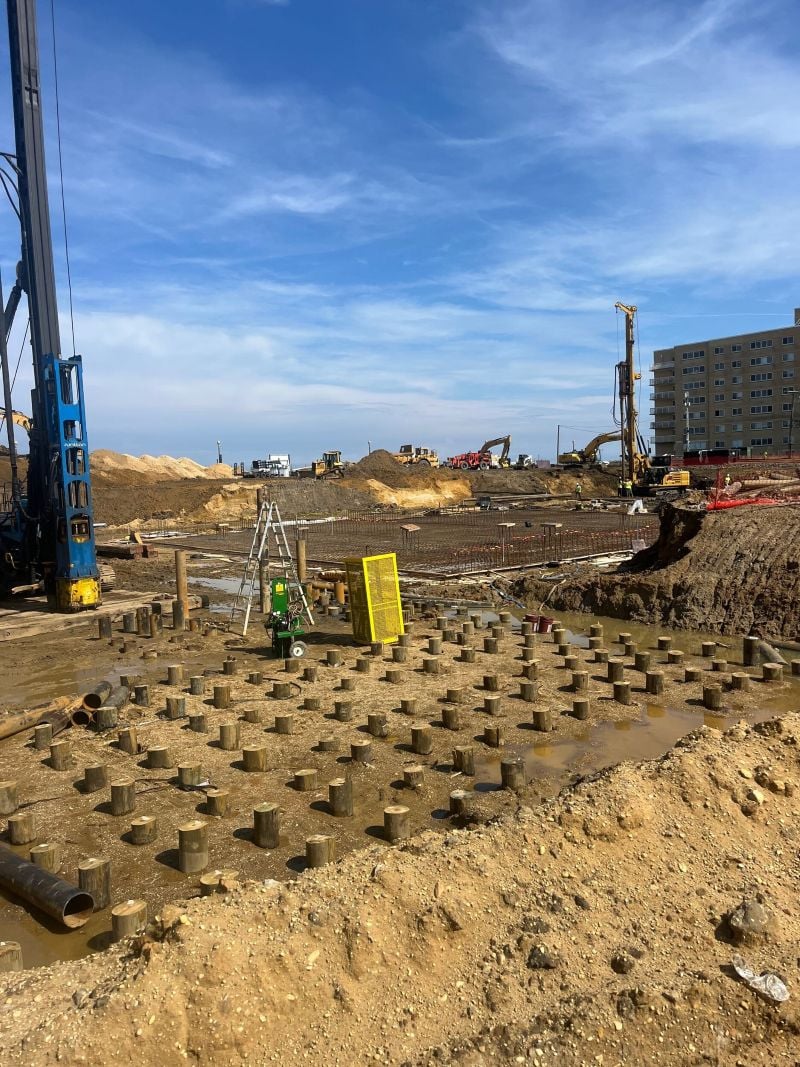
Not all soil strata or project footprints are created equal. At SJ Hauck, we don’t believe in one-size-fits-all foundation solutions. Our team utilizes a sophisticated range of deep foundation timber pile methodologies tailored to match the precise structural load specifications, challenging soil profiles, and unique environmental constraints of your coastal or commercial job site.
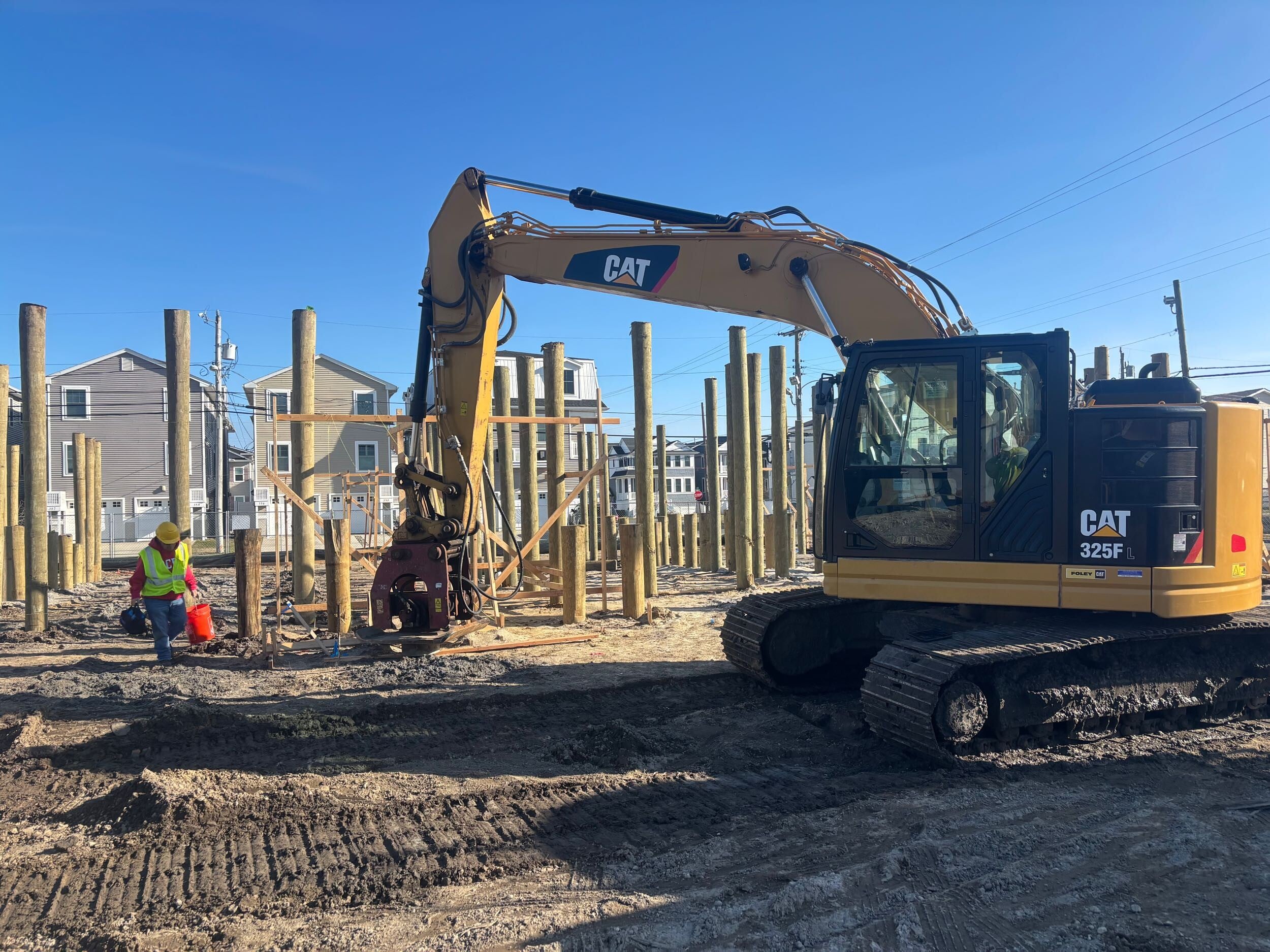
For deep cohesionless sand formations where a distinct bedrock layer is out of reach, driven timber piles represent the industry standard for high-durability, cost-effective deep foundations.
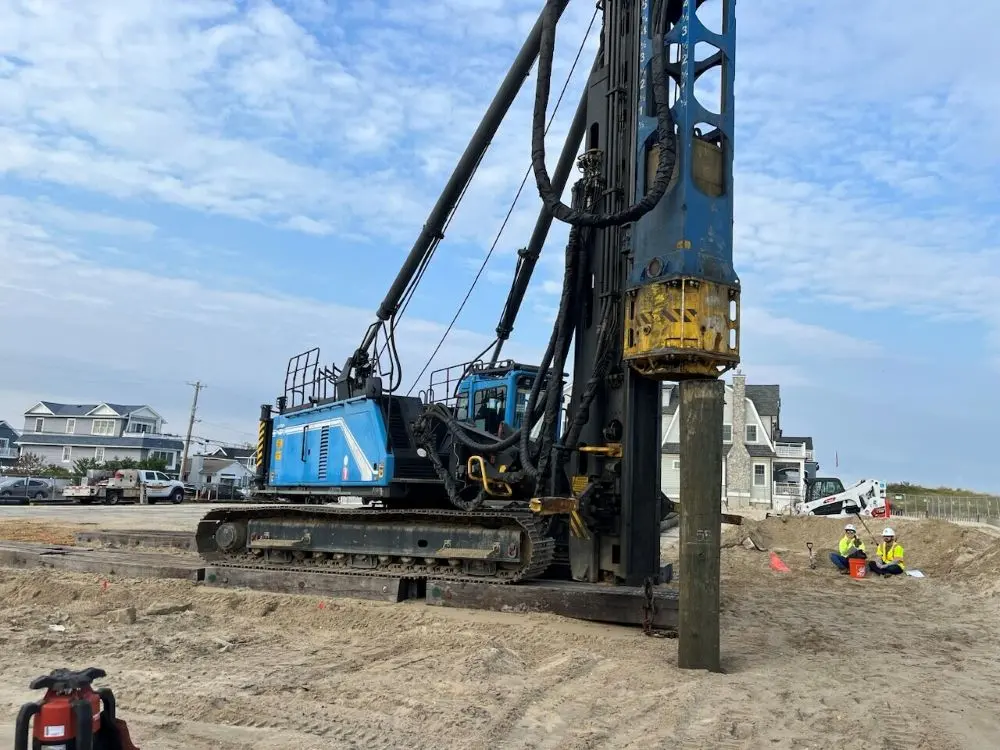
When navigating highly stratified coastal soils, the chosen installation method directly influences the long-term axial capacity of your foundation. SJ Hauck combines state-of-the-art heavy machinery with strict technical protocols to ensure every pile is driven to exact specifications without compromising material integrity.
Choosing concrete piling systems over timber or steel as common piling materials offers distinct structural advantages for high-complexity builds:
Elastic Lateral Resiliency
Unlike rigid concrete or steel, timber possesses natural elasticity and a superior strength-to-weight ratio. This allows timber piles to deform elastically to absorb, dissipate, and survive the dynamic, cyclic lateral forces of heavy wind, severe wave action, and extreme storm surges.
Unmatched Cost-Effectiveness
Driven timber piles represent the most economical deep foundation system for large-scale, open-site coastal elevations, infrastructure projects, and permanent underwater applications.
Longevity in Aggressive Soils
While steel piles are highly vulnerable to rapid rust and oxidation in brackish water, pressure-treated timber naturally resists chemical attack from acidic soils and extreme environments. When continuously submerged below the permanent water table, anaerobic conditions protect the wood from fungal decay, ensuring it lasts indefinitely.
The following table summarizes our specialized timber foundation methodologies tailored to specific Northeast soil conditions:
| Geotechnical Profile | Principal Soil Characteristics | Primary Structural Failure Risk | Optimal Pile Installation Protocol |
|---|---|---|---|
| Alluvial Beach & Barrier Sands | Cohesionless sand; highly permeable; susceptible to rapid movement. | Rapid scour and erosion; lateral displacement during storm surges. | High-pressure water jetting stopped 5 feet above target depth, followed by impact hammering to refusal. |
| Soft Clays & Silt | Highly cohesive; low permeability; high compressibility. | Long-term consolidation settlement; low lateral resistance. | Direct impact driving with heavy, short-stroke hydraulic hammers to maximize lateral compaction. |
| Urban Waterfront Fills (NYC/LI) | Erratically placed rubble; timber debris; thick overlying soft mud. | Hard driving obstructions; pile splitting; extreme misalignment. | Pre-augering a 10" pilot hole up to 10 feet deep, followed by impact driving with synthetic cushion blocks. |
| Dense Glacial Till & Gravel | Non-cohesive; highly compacted; contains large gravel and boulders. | Inability to reach design depth; tip crushing and splitting. | Heavy-duty impact driving with steel-pointed driving shoes, or pre-drilling using rotary equipment. |
Geology, localized flood zone designations, and regional regulations dictate deep foundation design. SJ Hauck possesses deep logistical, engineering, and geotechnical experience navigating the challenging coastal stratigraphy of the Northeast corridor, while maintaining a specialized heavy fleet built to mobilize nationwide.
New Jersey
We manage specialized coastal pile requirements along the Jersey Shore, successfully overcoming high water tables and loose sands. All designs strictly adhere to NJAC 5:23 (ASCE 24-24) frameworks, mandating risk-targeted elevations and deeper pile embedments to resist 500-year flood profiles and localized scour.
New York & Long Island
Delivering fully compliant deep foundation systems across Long Island’s sandy aquifers and the five boroughs. We expertly navigate strict NYC Administrative Building Codes and environmental restrictions under NYS Environmental Conservation Law (ECL) regarding structural timber treatments.
Delaware
Deploying high-capacity timber foundations designed specifically to withstand the highly saturated soils, extreme wave action, and high water tables of the Delmarva Peninsula.
Eastern Pennsylvania
Providing robust deep foundation solutions tailored to the region’s diverse geology.
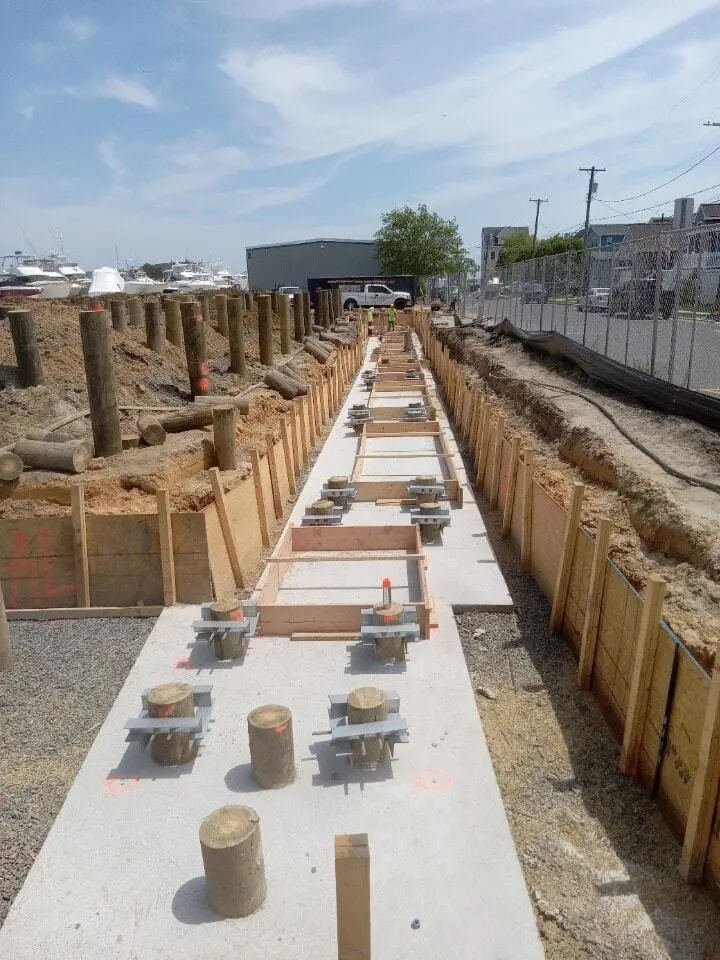
Deep foundations rely on flawless engineering, but the dirt beneath a coastal or urban waterfront job site rarely cooperates with a digital blueprint. When plans meet a subterranean obstruction or a shifting tidal table, navigating the challenge successfully requires heavy machinery guided by the sharp eyes, keen ears, and proven intuition of the field crew.
SJ Hauck delivers an IASM-accredited structural team equipped with advanced drilling rigs and a profound understanding of the site variables that software cannot predict.
The Intuition of the Hammer
Our operators don’t just watch digital readouts; they listen to the machine. They know the literal acoustic difference between a pile successfully taking up on a dense glacial till layer and a pile splitting against a buried urban boulder. That split-second field distinction saves commercial developers hundreds of thousands in hidden delays and compromised structural integrity.
Tidal & Logistic Mastery
Working in the mud, brackish water, and high-permeability sands of the Northeast corridor requires a specific kind of experience. We map our mobilization around tight environmental windows, strict regional codes, and shifting coastal tides so your project timeline stays intact.
The Engineer’s True Ally
We speak the language of your project engineers and general contractors. We don’t hide field anomalies; we collaborate in real time, offering transparent data and immediate mechanical solutions to keep the job moving forward safely.
We treat what we leave beneath the dirt with a level of intensity that borders on obsession. Because once our cranes and hammers roll off your site, your entire structural investment—and your professional reputation—stands squarely on top of the foundation we drove.

The transition to modern ASCE 24-24 standards introduces strict regulatory updates in flood hazard areas (V Zones and Coastal A Zones). Engineering calculations must now incorporate localized sea-level rise and shift toward probabilistic risk-targeting (such as resisting a 500-year or 750-year flood event instead of fixed base flood elevations). This requires significantly deeper pile embedment depths to survive the deeper scour and erosion profiles caused by extreme storm surges.
A deep foundation is only as strong as its connections. In structural coastal construction, timber piles are notched at the top to receive horizontal girders. Building codes strictly dictate that no more than 50% of the pile’s cross-sectional area may be removed. To resist massive uplift forces from wind and storm surges, connections must feature heavy-duty, corrosion-resistant through-bolts (minimum 3/4-inch diameter), spiked grids, or heavy Grade 316 stainless steel pile-to-beam brackets. Toe-nailing is strictly prohibited for structural load paths.
Axial compressive capacity is calculated using advanced soil mechanics that account for tip resistance ($Q_b$) and lateral shaft friction ($Q_s$). In the field, capacities are verified using precise dynamic pile-driving formulas. While standard engineering historically referenced the conservative Engineering News-Record (ENR) formula, real-world geotechnical studies show its field-measured safety factor sits lower than assumed. Therefore, SJ Hauck primarily utilizes the advanced Hiley Formula, incorporating hammer efficiencies, elastic compression values ($C_t$), and real-time blow counts to ensure maximum safety and compliance for heavy-duty commercial or municipal foundations.
Timber material compliance must strictly conform to ASTM D25 standards for round timber piles (Class A or Class B). Under regional regulations, timber piles driven to end bearing using an impact hammer must be Class A, featuring a minimum 8-inch tip diameter with a uniform taper. Furthermore, structural codes limit the allowable compressive stress of the timber to 1,200 psi for high-strength species like Southern Pine or Douglas Fir, and require structural inspections by a licensed professional engineer during installation to verify penetration resistance and pile integrity.