

When your residential, commercial, or marine project demands exceptional structural stability without the disruptive vibration and heavy footprints of traditional deep foundations, SJ Hauck Construction delivers high-performance engineered helical anchoring systems. Operating as premier deep foundation and structural relocation specialists throughout the Northeast and Mid-Atlantic, we provide advanced helical piles installation services designed to bypass unstable, water-saturated surface soils and anchor your structure securely into load-bearing strata.
Whether we are retrofitting a foundation beneath an elevated coastal home or stabilizing a commercial structure in a tightly packed urban zone, our engineering-first methodology guarantees a foundation designed to withstand extreme environmental forces for generations.
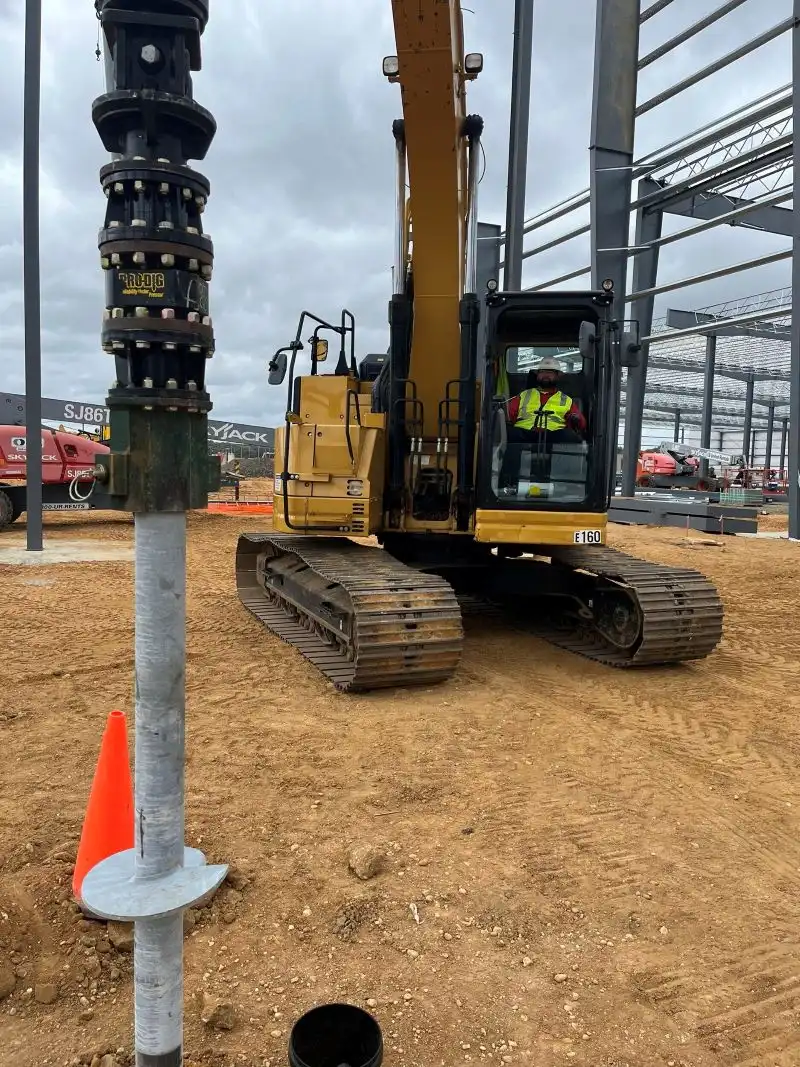
Not all coastal geologies or structural configurations present the same constraints. SJ Hauck utilizes specialized machinery and custom-engineered helical configurations to align perfectly with the precise structural loads, soil classifications, and tight physical parameters of your job site.
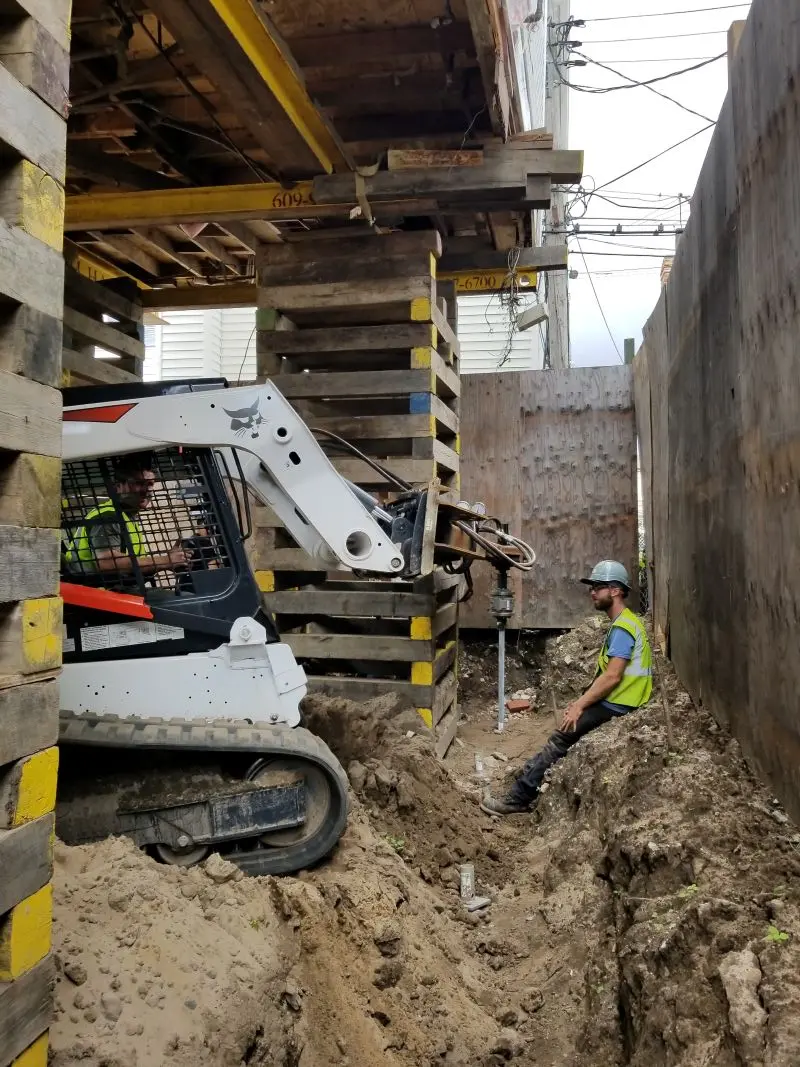
For structural elevation, house moving, and historical preservation projects, foundations must frequently be retrofitted directly underneath structures that are already elevated on temporary cribbing. Traditional impact pile drivers cannot navigate these low-overhead environments.
Our specialized line of both commercial and residential helical piles can be installed in modular, high-strength steel sections. We utilize compact, high-torque hydraulic equipment to rotate the lead helical sections directly under the existing footprint, adding extensions as necessary until reaching competent soil. This process ensures seamless foundation retrofits without compromising the structural integrity of the lifted home or building.
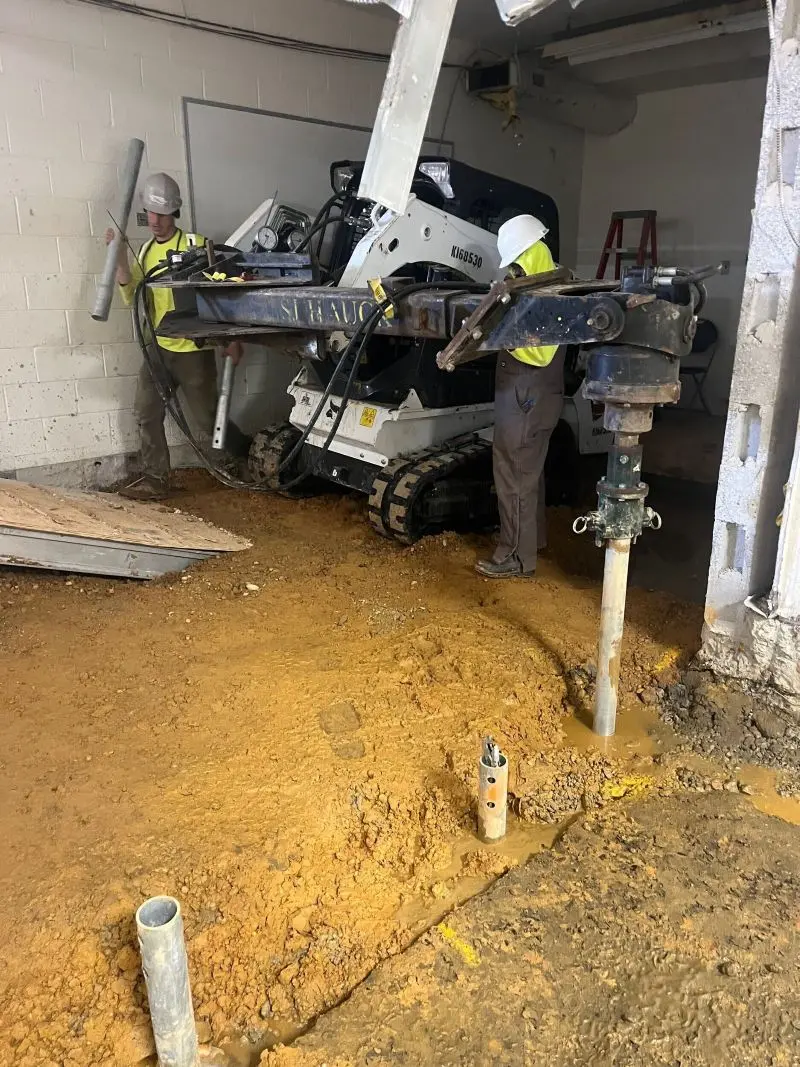
Modern helical construction relies on the precise mechanical advancement of steel plates into the soil matrix. By utilizing advanced multi-helix configurations (where multiple plates of varying diameters are welded to a single high-tensile shaft) we drastically increase the surface area distributing the structural load.
This enables us to achieve incredible axial compression capacities even in dense, restricted sites where large-scale drilling or driving rigs cannot gain physical access. The rotary installation cuts cleanly through soil profiles without generating structural spoils, maintaining an exceptionally clean and efficient site footprint.
Choosing specialized helical pile engineering over traditional driven timber or poured concrete systems provides several critical mechanical and logistical advantages for high-complexity structural projects:
Unlike impact hammers that send severe shockwaves through the earth, helical piles are screwed into the ground with smooth hydraulic torque. This completely eliminates the risk of structural settlement, cracking, or cosmetic damage to closely adjacent neighboring homes and sensitive urban foundations.
Helical piles require absolutely zero concrete curing time. The moment the pile reaches its targeted torque depth, it is fully capable of supporting its design load. This allows SJ Hauck to quickly lower elevated structures onto their new permanent foundations, radically condensing project timelines and minimizing weather exposure risk.
In coastal storm zones, buildings must resist more than just downward gravity loads; they must withstand intense hydraulic uplift and high wind forces. The helical plates act as built-in underground earth anchors, binding the pile to the deep soil matrix. Furthermore, because the load is transferred far below the FEMA-predicted “scour line,” the building remains safe even if surface sands completely wash away during a storm surge.
To prevent degradation from brackish groundwater, acidic soils, and coastal environments, our steel shafts are fully hot-dip galvanized according to ASTM standards, offering decades of maintenance-free subterranean lifecycle performance.
| Pile Type / Shaft Configuration | Primary Installation Mechanism | Noise / Vibration Footprint | Typical Depth Range | Key Structural Advantage |
|---|---|---|---|---|
| Square Shaft (SS) Piles | Hydraulic Rotary Motor (High-Torque Drive) | Negligible / Extremely Low | 20’ – 80’ | Highest torque-to-strength ratio; ideal for high-tension underpinning and tight residential footprints. |
| Round Shaft (RS) Piles | Hydraulic Rotary Motor (High-Torque Drive) | Negligible / Extremely Low | 20’ – 120’ | High structural section modulus; provides superior lateral stiffness against wind and moving water. |
| Combo / Hybrid Piles | Square-to-Round Transition Couplers | Negligible / Extremely Low | 30’ – 100’ | Maximizes deep soil engagement via square lead sections while utilizing round shafts near the surface for lateral strength. |
Geological anomalies and strict regional building ordinances dictate structural deep foundation designs. As premier helical pile contractors, SJ Hauck brings decades of logistical mastery and specific geotechnical experience navigating the diverse, challenging soil profiles of the Northeast corridor.
New Jersey
Managing complex coastal engineering demands across the Jersey Shore (overcoming high water tables, shifting sand layers, and strict NJDEP coastal regulations) while providing low-profile installations for historic elevations in Cape May, Atlantic City, and Ocean City.
New York
Delivering fully compliant structural deep foundations within the five boroughs under strict building codes, executing vibration-free retrofits on Long Island’s sandy aquifers, and handling variable alluvial deposits upstate.
Pennsylvania & Delaware
Deploying high-capacity tension and compression helical piers across the varied bedrock formations of the Delaware Valley and the highly saturated soils of the Delmarva Peninsula, where shallow foundations are prone to structural failure.
While many contractors can twist a steel shaft into the ground, SJ Hauck approaches deep foundations from a position of total structural mastery. We don’t just install piles; we engineer complete stabilization solutions for the most unforgiving environments in the Northeast.
Here is why commercial developers, structural engineers, and coastal homeowners trust us with their foundations:
Dual Expertise in Lifting and Foundation Engineering
We are premier structural relocation and house-lifting specialists. This means we possess a profound understanding of how a building behaves above the ground, allowing us to design and execute helical retrofits beneath elevated structures with flawless structural alignment.
Empirical Data Transparency
We eliminate guesswork. Every single modular section we install is tracked via calibrated digital pressure gauges. You receive fully documented torque logs mapped directly to your project’s engineered load requirements ($K_t$) for absolute compliance verification.
Frictionless Regulatory & Environmental Navigation
We thrive in highly regulated zones. Whether navigating complex NJDEP coastal regulations, stringent NYC building codes, or delicate FEMA flood plain guidelines, our team manages the compliance hurdles that frequently stall other contractors.
Tight-Access Specialized Rigs
We maintain a proprietary fleet of low-overhead, high-torque hydraulic machinery designed specifically to operate inside cramped urban basements, beneath homes sitting on temporary cribbing, or along fragile marine bulkheads.
Driven timber piles are excellent for wide-open new construction, but they require massive impact driving rigs that create extreme vibration and cannot physically fit beneath a home that has already been lifted on cribbing. Helical piles are ideal for retrofits and tight property setbacks. They can be installed in short modular segments using compact equipment operating directly underneath or adjacent to a raised structure, creating zero ground vibrations that might threaten neighboring properties.
Engineers verify the ultimate load capacity of a helical pile by utilizing the empirical relationship between installation torque and soil resistance, known as the torque-to-capacity ratio ($K_t$). As our hydraulic equipment screws the pile into the earth, we constantly monitor the real-time installation torque using calibrated digital pressure gauges. When the required engineering torque is maintained across targeted deep soil strata, we have mathematical verification that the pile will safely support its engineered compression and tension limits.
Yes. While helical piles are primarily recognized for their exceptional axial compression and tension (uplift) capabilities, lateral stability is achieved through precise engineering design. For projects subject to heavy lateral forces, we utilize larger-diameter round shafts which offer higher section modulus and bending resistance. Where lateral forces are extreme, piles can be installed at an angle, known as a battered pile, to directly counteract horizontal forces from moving water and high winds.