
Concrete underpinning is one of the most consequential structural interventions an engineering team can perform. When an existing commercial foundation no longer safely carries its structural load, settles, or requires modification for deeper excavations, underpinning extends, strengthens, and permanently transfers those building loads to competent load-bearing strata.
As the East Coast’s premier underpinning team, SJ Hauck Construction delivers the precision engineering, specialized equipment, and deep geological expertise required to secure high-stakes commercial assets. This guide breaks down primary underpinning methodologies, walks through our sequential concrete underpinning process, and highlights the rigorous technical standards demanded by complex commercial projects.

Visible Structural Distress
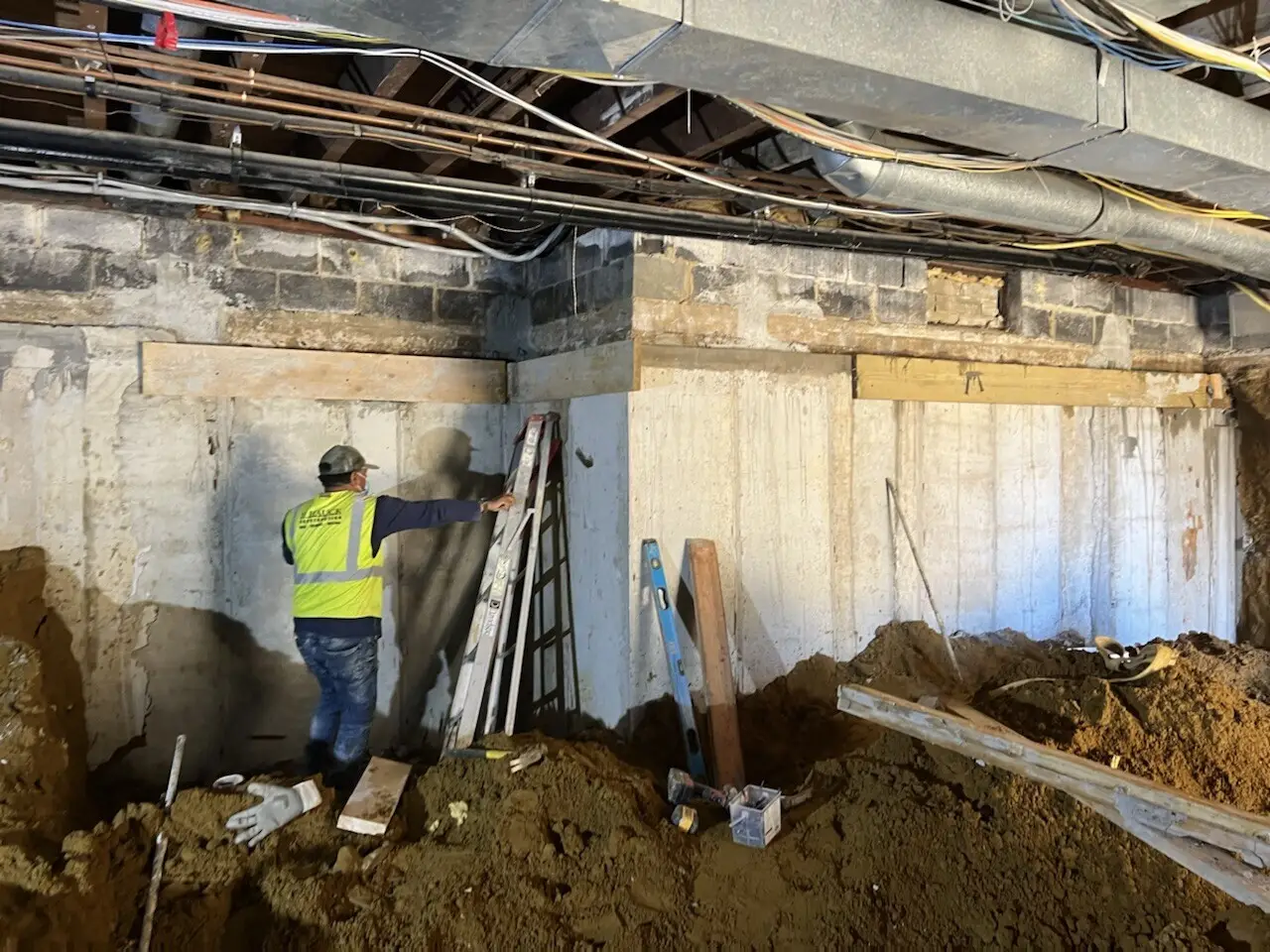
Structural cracks in masonry walls, bowing slabs, or doors and windows that stick within their frames due to differential settlement.

Soil Degradation & Subsidence
Shifting topsoil layers, high water tables (common in coastal regions), or broken underground utilities that erode the ground directly beneath concrete walls.

Vertical Expansion & Renovations
Modifying an existing commercial facility or business complex to add floors, requiring added support that the original foundation cannot handle.

Deep Basement Expansion Projects:
Extending foundation systems to safely accommodate deeper excavations and new below-grade construction.

Adjacent Excavation Activity
Nearby excavation for utilities, transit lines, or adjacent buildings that disturbs the soil cone supporting your existing footprint.
Underpinning upgrades or remediates an existing foundation that has been compromised by environmental shifts, age, or changed operational demands. Rather than just patching cracked concrete, professional underpinning provides permanent load-path certainty.
SJ Hauck Construction provides definitive intervention across several core categories:
Structural Deterioration & Settlement Rectification
Stabilizing and reinforcing structures showing advanced signs of foundation failure or loss of load-bearing capacity.
Usage & Weight Changes
Upgrading facility infrastructure to support vertical expansions, heavy machinery, or structural retrofits that create immense structural loads the original foundation was never engineered to handle.
Soil Instability & Environmental Factors
Mitigating the risks of shifting soil layers, high water tables, and moisture fluctuations—from the clay-heavy soils of Long Island to the sandy, tidal zones of the Mid-Atlantic coast—that undermine shallow footings.
External Disturbances
Defending your facility against deep excavations on adjacent properties that pose an immediate risk of structural movement or collapse.
Selecting the proper underpinning methodology based on specific structural demands, site access, and geotechnical soil boring reports is critical to long-term safety.
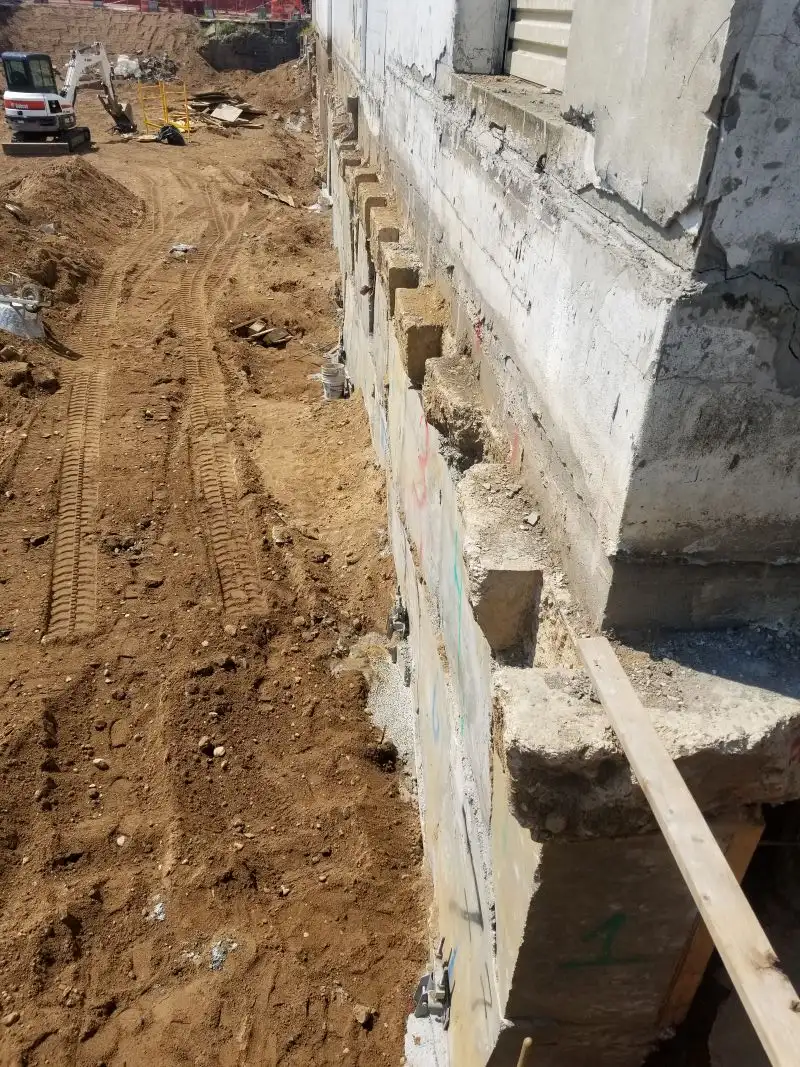
The traditional, time-tested method where our crews excavate sequential pits beneath the existing foundation and fill them with high-strength concrete. This process relies on extending the foundation depth down to a more stable soil layer without compromising the upper structure. It is highly effective for shallower soil remediation where stable strata sit within accessible depths.
Perfect for restricted-access environments, low headroom, and high-load commercial facilities. High-capacity steel piles are driven or drilled deep into competent strata or bedrock to anchor settling walls and stabilize immense structural weight, bypassing weak upper soil layers entirely.
Utilized when internal access to the building or basement is entirely restricted. External steel needle beams are installed through structural walls to transfer load paths safely during foundation underpinning reinforcement, allowing work to proceed without disrupting interior floor zones.
Ideal for commercial buildings experiencing distress from shifting topsoil layers or surface moisture. These specialized piles are screwed mechanically deep into the ground, providing immediate added support and load-bearing capabilities with minimal vibration, protecting sensitive structures from construction-induced movement.
Executing safe foundation underpinning requires a rigorous, highly sequential engineering plan to eliminate structural risk, protect property value, and shield businesses from liability.
Step 1: Geotechnical Analysis & Engineering Design
Before work begins, engineers evaluate soil boring reports and existing foundation schematics. The engineering team maps the building’s current weight distribution to determine the precise depth required to reach competent load-bearing soil or bedrock.
Step 2:Structural Support & Precision Jacking
Temporary support and shoring systems are deployed to maintain total structural stability. Backed by our advanced fleet of high-pressure hydraulic jacks and unified synchronous jacking systems, we ensure uniform weight distribution across precision load points, protecting the existing structural fabric from localized distortion.
Step 3:Sequential Pit Excavation ("Legs and Spaces")
To prevent localized settlement, excavation never occurs beneath an entire foundation at once. Crews utilize a strict “legs and spaces” protocol, digging isolated, strategically spaced pits (typically 3 to 4 feet wide) in a predetermined, alternating sequence. This ensures the building remains safely supported by unexcavated earth at all times.
Step 4:Concrete Pouring & Dry Packing
Once an individual pit reaches its engineered depth, structural reinforcement rebar is installed, and high-strength concrete is poured to within a few inches of the existing foundation’s underside. After the concrete cures, the remaining gap is packed tightly with an expansive, non-shrink grout to seamlessly lock the new foundation to the old structure.
Step 5:Load Transfer & Final Stabilization
With all sequential underpinning pins completely cured, temporary shoring systems are carefully decommissioned. The building’s structural load is safely, permanently, and evenly transferred down to its new, reinforced footprint, delivering a definitive solution to past settlement issues.
Commercial underpinning is a highly specialized discipline that leaves zero room for guesswork. Because of the extreme structural loads involved, projects must be handled by an experienced underpinning contractor with a proven background in heavy shoring, structural moving, and rigging.
Risk Mitigation
Unvetted contractors risk causing differential settlement or catastrophic wall failure by over-excavating or ignoring strict sequential digging protocols. SJ Hauck brings precision engineering and real-time monitoring to every site.
Regulatory Compliance & Submittals
Commercial projects must align completely with regional building codes (such as NYC Building Code Chapter 33 or the NJ Uniform Construction Code).
The Value of Documentation
Property owners and asset managers must retain all engineering design drawings, certified soil reports, and load-transfer documentation to protect property value during future refinancing, structural expansions, or commercial real estate sales.
High-stakes commercial construction support, historic stabilization, and deep foundation underpinning require elite load-path certainty—no matter where your project is located. While SJ Hauck Construction is proudly headquartered in New Jersey, we are a fully equipped national contractor. Our specialized crews, high-capacity hydraulic systems, and heavy rigging equipment routinely mobilize to job sites across the United States, bringing elite structural solutions to complex engineering challenges nationwide, with concentrated expertise in our core markets:
Mid-Atlantic & Tri-State Regional Excellence:
New Jersey (Home & HQ)
Comprehensive statewide coverage, including high-load urban centers in North Jersey (Hudson, Bergen, Essex), institutional retrofits in Central Jersey, and specialized coastal, high-water-table underpinning across the Jersey Shore (Atlantic, Cape May, and Ocean counties).
New York & Long Island
Navigating dense urban infill constraints and strict adjacent property protection laws in NYC and Long Island, as well as addressing hydrostatic pressure in the Southern Tier.
Pennsylvania & Delaware
Managing facade retention for adaptive reuse projects in Greater Philadelphia, and providing deep foundation solutions for commercial assets facing beach erosion along the Delaware Coast.
From coast to coast, we transport our advanced unified synchronous jacking systems and heavy-duty machinery directly to your project site, ensuring identical high-caliber precision and safety standards anywhere in the country.
Whether you need to stabilize a settling facility, support a vertical expansion, or secure deep excavations, our team brings unmatched precision engineering to your site.