
The New Jersey Back Bays Plan: Why the Army Corps Is Choosing Elevation and Marsh Restoration Over Massive Storm Gates
- SJ Hauck Construction
- Dec 30, 2025
- 5 min read

The New Jersey Back Bays Coastal Storm Risk Management Study (NJBB) is one of the most important long-range plans shaping how coastal New Jersey will deal with back-bay flooding over the coming decades. Led by the U.S. Army Corps of Engineers (USACE) Philadelphia District in partnership with NJDEP, the study looks at nearly the entire back-bay system behind the barrier islands of Monmouth, Ocean, Burlington, Atlantic, and Cape May Counties. (nap.usace.army.mil)
The official project page for the New Jersey Back Bays Coastal Storm Risk Management Study outlines the latest draft plan released in December 2024: a “Tentatively Selected Plan” (TSP) built around elevating homes, floodproofing critical facilities, and restoring marshes—not constructing massive inlet storm gates. (nap.usace.army.mil)
For municipalities, engineers, and contractors working in the bayside communities, this shift has direct implications for what projects will be funded, permitted, and prioritized.
Study Area and Purpose of the New Jersey Back Bays Plan
The NJBB study area:
Covers about 950 square miles
Includes nearly 3,400 miles of shoreline
Spans 89 municipalities behind the barrier islands from Monmouth to Cape May Counties (nap.usace.army.mil)
The purpose is to evaluate Coastal Storm Risk Management (CSRM) strategies that reduce flood damages to:
Population and housing
Critical facilities (emergency services, hospitals, utilities)
Key infrastructure and property
Sensitive ecosystems
USACE’s December 2024 news release notes that without action, the back-bay region could experience an estimated $2.6 billion in average annual flood damages under future conditions. (nap.usace.army.mil)
From Storm Gates to Nonstructural Measures: What Changed?
Earlier phases of the NJBB work—especially the 2021 draft—were closely watched because they included large storm-surge barriers at inlets such as Barnegat, Manasquan, and Great Egg Harbor, along with cross-bay barriers. (nap.usace.army.mil)
In the December 2024 Supplemental Draft Integrated Feasibility Report, USACE pivoted:
The current Tentatively Selected Plan removes the massive inlet storm gates and cross-bay barriers from the preferred approach.
Instead, the TSP is built around three main components: (nap.usace.army.mil)
Elevating approximately 6,400 residential structures
Floodproofing 279 critical infrastructure facilities (police, fire, EMS, hospitals, etc.)
Implementing nature-based solutions by using dredged material to enhance about 217 acres of salt marsh at seven locations in the back-bay system
According to USACE, the surge-barrier concepts required extensive additional engineering, environmental, and navigation analysis, carried very high capital costs, and posed significant long-term operational and ecological questions. The updated plan is framed as more feasible in the near term while still delivering significant risk reduction. (nap.usace.army.mil)
Core Elements of the Tentatively Selected Plan
1. Elevation of Approximately 6,400 Homes
The plan proposes elevating about 6,400 residential structures in areas where flood depths, frequency of loss, and cost-effectiveness support nonstructural treatment. (nap.usace.army.mil)
For industry professionals, “nonstructural” on paper translates into very structural work in the field:
Temporary support and lifting of existing structures
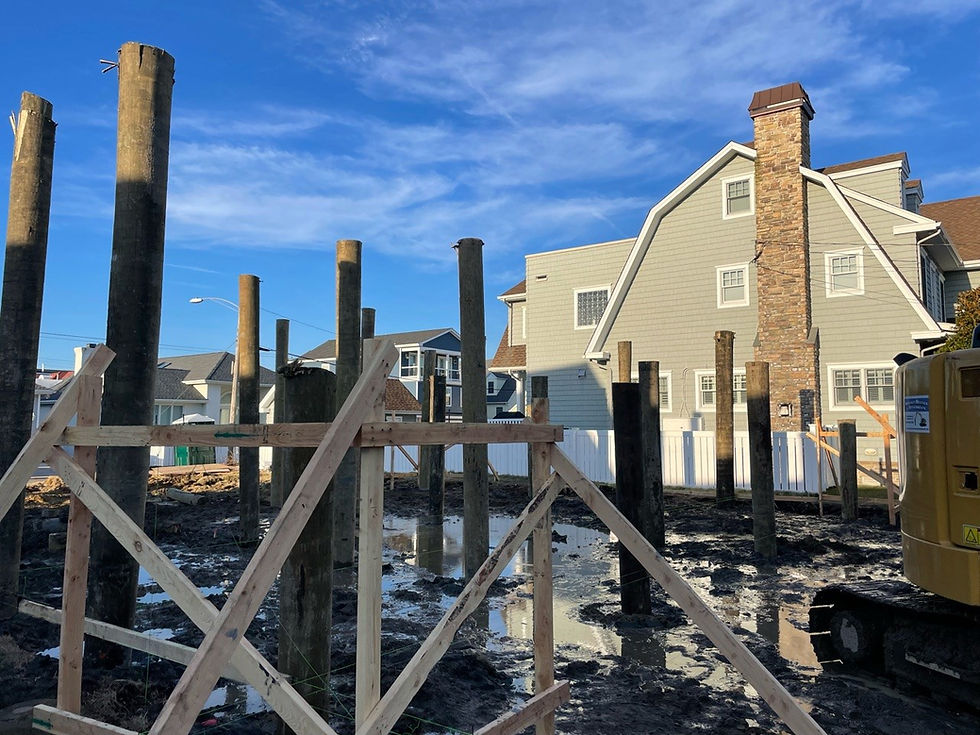
New or modified foundations and, in many cases, pile-supported systems
Integration with new utilities, access stairs, ramps, and site grading
Implementation would occur in phases and rely on a combination of federal funding, state cost-share, and local participation programs. The details of how communities and individual owners enroll will be clarified in later phases, but the direction of travel is clear: elevation will be a primary tool, not a niche solution.
2. Floodproofing 279 Critical Infrastructure Facilities
The TSP also targets 279 critical infrastructure facilities for floodproofing. (nap.usace.army.mil)
These include:
Police and fire stations
EMS buildings
Hospitals and health facilities
Other essential services
Measures could range from elevating sensitive equipment and utilities to dry or wet floodproofing of structures, small perimeter systems, or selective site regrading. For engineers and contractors, this means:
Multi-discipline coordination (architecture, MEP, structural, civil)
Careful phasing to keep critical services operational
Design that aligns with both USACE guidance and local code requirements
3. Nature-Based Solutions: 217 Acres of Marsh Enhancement
The third major pillar is a set of nature-based solutions (NBS), specifically enhancing 217 acres of salt marsh at seven locations using dredged material. (nap.usace.army.mil)
These marshes are intended to:
Act as buffers that absorb wave energy and storm surge
Improve habitat and ecosystem resilience
Integrate with existing navigation dredging and sediment-management programs
While many construction firms will not directly work on the marsh platforms themselves, these features influence:
Local flood depths and wave conditions used in design
Permitting windows and environmental constraints
The overall risk context for back-bay development and infrastructure
Why USACE Is Favoring This Mix: Economics and Feasibility
The NJBB plan formulation and economics appendices compare a range of structural, nonstructural, and nature-based options. (nap.usace.army.mil)
Key reasons cited for the current TSP:
Cost-effectiveness: Elevating homes and floodproofing critical facilities, in combination with targeted marsh restoration, delivers meaningful damage reduction at a lower overall cost than mega-structures at the inlets. (nap.usace.army.mil)
Environmental impact: Large surge barriers raised concerns about impacts on tidal exchange, sediment transport, fisheries, and navigation.
Implementation reality: The nonstructural + NBS package is seen as more achievable in the near term, given existing planning, funding, and environmental-review frameworks.
Stakeholders and independent reviewers do raise questions—for example, whether marsh components prevent enough damage relative to their cost, or whether broader structural options should remain on the table. (thesandpaper.net)
But as of late 2025, the TSP is the clearest signal of how federal and state partners propose to manage storm risk in the back bays.
What This Means for Back-Bay Communities and the Industry
Elevation Is Becoming Central, Not Peripheral
The NJBB plan effectively confirms that elevating existing at-risk structures is now a core federal strategy for back-bay flood risk, not a side option offered only after major events. (nap.usace.army.mil)
For municipalities and regional planners, that implies:
Hazard-mitigation plans and capital programs should bake elevation into their long-term strategy, not treat it as homeowner-by-homeowner improvisation.
Local zoning, freeboard requirements, and design standards are likely to continue moving in the direction of higher finished-floor elevations and open foundations in high-risk zones.
For structural-lifting and foundation specialists, it suggests a sustained market for:
Complex elevation projects on older housing stock
Integrated solutions that address both structural support and access, utilities, and code compliance
Stronger Linkages With State Policy (NJPACT / REAL)
The NJBB federal study is moving forward alongside New Jersey’s own regulatory updates under NJPACT, including the REAL land-use and flood-hazard rules that propose to raise the coastal regulatory design flood by BFE + 4 feet and expand mapped flood-hazard areas. (nap.usace.army.mil)
Over time, industry should expect:
Increasing alignment between USACE project assumptions and NJDEP regulatory baselines
A back-bay environment where elevated, resilient structures are standard practice rather than exceptions
Long Timeline, Clear Direction
USACE and NJDEP note that after environmental review and final approvals, implementation could span a decade or more, with phased work across multiple municipalities. (Permitting Dashboard)
For contractors, designers, and local governments, that means:
This is not a one-year grant program; it is a multi-year structural shift in how back-bay risk reduction is designed and funded.
Firms that build expertise in elevation, floodproofing, and construction in tight, flood-prone back-bay settings will be better positioned as communities begin to move from planning to execution.
How Communities and Project Teams Can Prepare
To position effectively for the NJBB era:
Municipalities should align local hazard-mitigation and capital plans with the NJBB elevation and floodproofing approach, and identify priority neighborhoods and facilities early.
Engineers and architects should integrate elevation and nonstructural strategies into feasibility studies and master planning now, rather than waiting for project-by-project mandates.
Contractors and specialty firms should invest in the logistics, equipment, and compliance processes required to elevate and protect structures at scale in constrained, water-adjacent environments.
The bottom line is straightforward: For New Jersey’s back-bay communities, the Army Corps is clearly signaling that the path forward is elevate structures, harden critical facilities, and restore marshes—not rely on future giant inlet gates to save the day.
If your work touches coastal planning, design, or construction in these areas, that is the framework you will be building in.
SJ Hauck Construction is one of the Northeast's premier resources for information and action when it comes to living in flood-prone coastal zones.


Comments