
The Essential Role Of Pile Driving In Building Strong Foundations
- SJ Hauck Construction
- Oct 10, 2025
- 3 min read

What Does Pile Driving Do?
Pile driving installs long, column-shaped supports called piles into the ground to carry building loads to stable soil or rock layers. The process allows a structure to rest on material that will not compress or wash away.
In coastal areas or regions with soft, saturated soils, surface layers cannot handle heavy loads. Piles bypass these weak layers and transfer the weight of the building deeper underground.
What Is The Purpose of Pile Driving?
The main purpose of pile driving is to create a foundation that resists settlement and shifting. Engineers specify pile foundations when soil testing shows that the upper layers have poor bearing strength.
Pile driving supports:
Homes in flood-prone or coastal zones
Bridges, piers, and elevated platforms
Large commercial or municipal structures
Buildings where erosion, scour, or groundwater pose risks
In New Jersey and other FEMA floodplain areas, pile-driven foundations are often required to meet elevation and load-bearing standards.


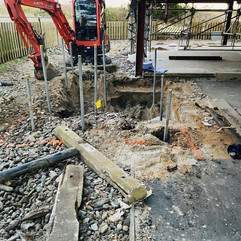


What is a Pile Drive?
A pile drive, or pile driver, is the equipment used to install piles. Machines vary by project type and soil condition.
Common equipment includes:
Diesel or hydraulic hammers that deliver vertical impact to drive steel, concrete, or timber piles
Vibratory drivers that use high-frequency motion to reduce soil friction and seat piles in place
Press-in systems that hydraulically push piles into the ground without vibration for noise-sensitive areas
Pile drivers operate until each pile reaches a measured resistance that indicates it has reached stable bearing strata.
Why Pile Foundations Are Important
A pile foundation supports structures that cannot rely on shallow footings. It provides a direct load path from the structure to deeper, more stable soil or rock.
Advantages include:
High load capacity suitable for multi-story or heavy structures
Resistance to soil movement, erosion, and flooding
Compatibility with both land and marine construction environments
Long service life with minimal maintenance when properly designed and installed
Pile foundations are often the only reliable option where conventional footings would fail or shift.
What A Pile Foundation Is
A pile-driven foundation is the completed system formed after piles are installed and connected at the surface. Each pile is cut to the required height, capped, and tied together to distribute loads evenly.
Common configurations include:
Steel or precast concrete piles used for residential elevation or commercial loads
Timber piles used in lighter structures or where treated wood performs well in wet soil
Helical piles used where access is limited or vibration must be avoided
Pile-driven foundations are common in waterfront and flood-elevation projects throughout the Mid-Atlantic region.
The Basic Stages of Pile Driving
Site and soil testing. Engineers determine bearing capacity and required pile depth.
Pile selection. Material and size are chosen based on load, soil type, and exposure.
Driving. The pile driver installs each pile to the target depth or resistance.
Cutting and capping. Piles are trimmed to level height and capped in reinforced concrete or steel.
Structural tie-in. The foundation frame or beam system connects to the pile caps.
Instrumentation during driving records energy, blow count, and depth to verify performance.
When Is Pile Driving Used?
Pile driving is used when:
Surface soils are weak or compressible
Groundwater levels are high
Structures must resist uplift, scour, or lateral loads
A new foundation must integrate with existing or damaged footings
In the Mid-Atlantic, pile systems are standard for flood-elevated homes, marinas, and commercial coastal projects.
Common Types Of Piles
End-bearing piles transfer loads directly to hard rock or dense strata. Friction piles rely on adhesion between the pile surface and surrounding soil. Combination piles use both mechanisms when loads are high or soil conditions vary.
Typical materials:
Steel H-piles for deep or high-load applications
Precast concrete piles for uniform bearing and corrosion resistance
Treated timber piles for light structures in saturated soils
Helical piles for modular or retrofit projects
Pile driving in the Mid-Atlantic
SJ Hauck Construction performs pile driving and deep foundation work across New Jersey, Pennsylvania, and Delaware. The company installs steel, timber, and concrete pile systems for residential elevations, bridge work, and commercial sites. We use hydraulic and vibratory drivers suitable for coastal and inland soil conditions.
Pile installation services include:
Pile foundations for new construction
Structural elevation and relocation
FEMA-compliant flood mitigation
Helical and retrofit piling for limited-access properties
At SJ Hauck Construction, we understand that having a solid foundation is crucial not only for buildings but also for your peace of mind. With experience spanning from New Jersey to Florida, we provide the expertise necessary to construct stronger, smarter, and safer structures for future generations.